
BOMBANANA! Puzzle Modules: All 14 Modules Solved
All 14 puzzle modules in BOMBANANA! Complete breakdown of wire cutting rules, maze navigation, keypad symbols, memory stages, pressure dials, and CHAOS event protocols.
BOMBANANA! features 14 puzzle modules: 11 standard logic modules (Wires, Keypad, Symbols, Maze, D-Pad, Switches, Memory, Complex Wires, Simon Colors, Pressure Dial, Status Pulses) and 3 CHAOS hazard modules requiring three-monkey relay teamwork.
Complete 14 Puzzle Modules Overview
In BOMBANANA!, defusing a bomb is an intense test of asymmetric communication. The 14 modules fall into two operational categories:
- 11 Standard Logic Modules: Require observation from the Deaf Monkey, manual decoding by the Mute Monkey, and physical manipulation by the Blind Monkey.
- 3 CHAOS Event Modules: Environmental hazards that suddenly trigger during a run to disorient the squad and overload the Blind Monkey.
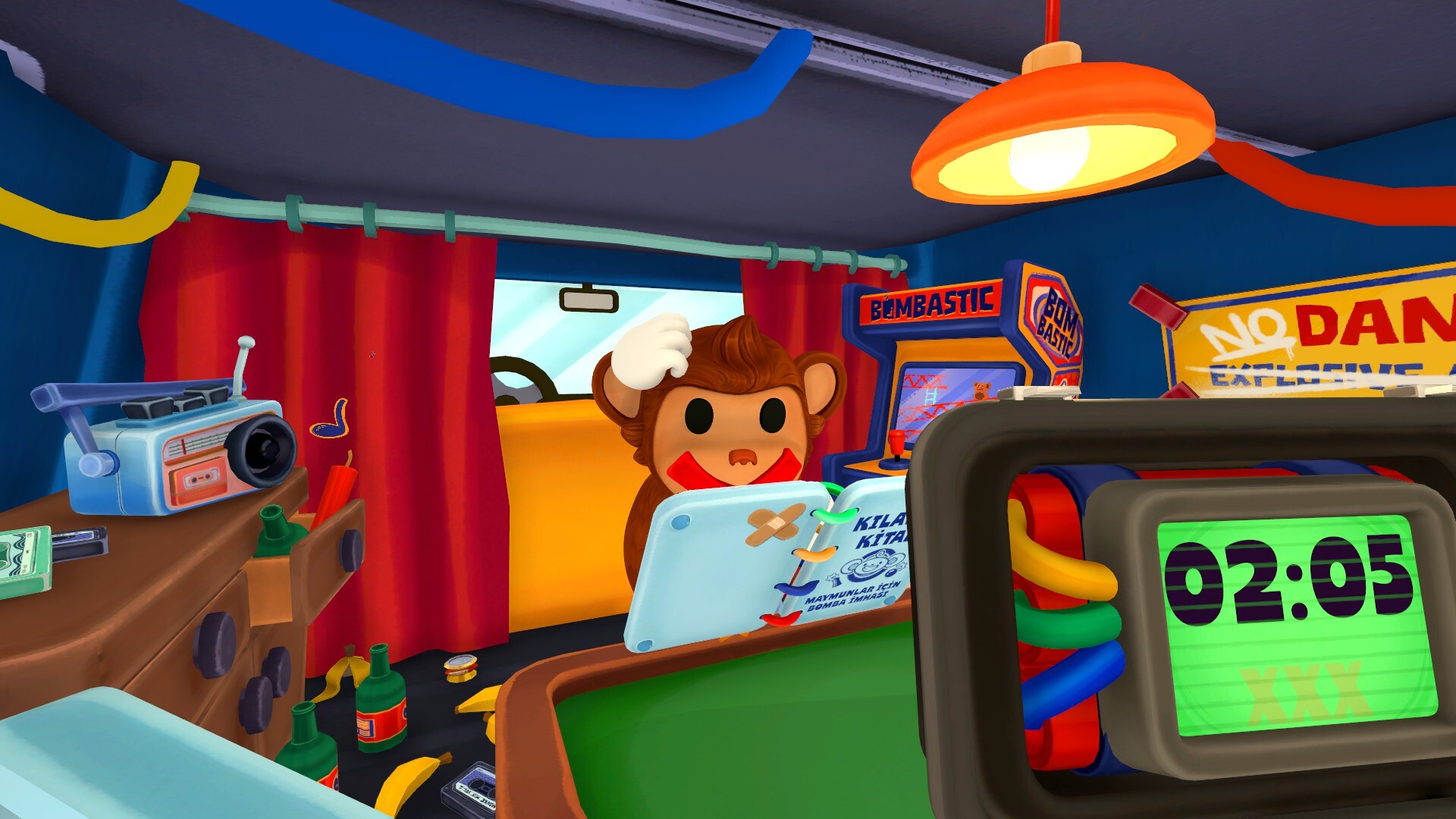
1. Wire & Cable Modules (Simple & Complex Wires)
Wire modules are the most common early-game challenge. Success depends on reporting the exact state before touching any shears:
Simple Wires (3 to 6 Wires)
- The Callout Protocol: Deaf Monkey calls:
"[Wire Count] Wires: [Color 1], [Color 2]... [LED Indicator Color]". - Standard Decision Rules (Mute Manual Reference):
- 3 Wires:
- If there are no Red wires $\rightarrow$ Cut the Second wire.
- If the last wire is White and LED is Green $\rightarrow$ Cut the Last wire.
- If there is more than one Blue wire $\rightarrow$ Cut the Last Blue wire.
- Otherwise $\rightarrow$ Cut the Third wire.
- 4 Wires:
- If there is more than one Red wire and LED is Red $\rightarrow$ Cut the Last Red wire.
- If the last wire is Yellow and there are no Red wires $\rightarrow$ Cut the First wire.
- If there is exactly one Blue wire $\rightarrow$ Cut the First wire.
- Otherwise $\rightarrow$ Cut the Second wire.
- 5–6 Wires: Always count from top to bottom. If the LED flashes yellow, prioritize cutting the ground wire (striped yellow/black).
- 3 Wires:
Complex Striped Wires
Complex modules feature striped wires with individual mini-LEDs and star symbols beneath each terminal. The Mute Monkey uses a Venn diagram in the manual:
- Wire has Red + Star: Cut only if serial number contains an odd digit.
- Wire has Blue + LED lit: Do not cut (high-voltage ground).
- Wire has No Color / Plain White: Cut if no LED is lit.
2. Spatial & Coordinate Modules
The Maze Module
The maze is a grid where walls are invisible to the operative manipulating the movement toggle:
- Blind Monkey: Feels the Braille numeral at their current cell and observes the red position indicator light.
- Deaf Monkey: Sees the green exit light at the target destination.
- Mute Monkey: Has the full maze map in the manual.
- Navigation Protocol:
- Blind calls out start coordinates:
"Position: Row 2, Column 3". - Deaf calls out exit coordinates:
"Exit: Row 5, Column 1". - Mute charts the pathway and uses directional pointing gestures:
[Up] -> [Right] -> [Right] -> [Down]. - Wall Collision Penalty: Hitting an invisible wall causes a strike and teleports the Blind Monkey back to the start position; the exit location remains fixed.
- Blind calls out start coordinates:
D-Pad & Directional Compass
- Deaf Monkey reports the target cardinal arrow displayed on the screen (
North,East,South,West). - Mute Monkey checks the rotation offset table (which shifts directions based on battery count).
- Blind Monkey taps the directional pad exactly once per confirmed signal.
3. Symbolic & Memory Modules
Keypad & Ancient Glyphs
- Four buttons with arcane symbols appear on the module.
- Mute Monkey scans the six vertical columns of symbols in the manual.
- The squad must identify which single column contains all four symbols present on the bomb.
- Blind Monkey must press the buttons in order from top to bottom as they appear in that specific column, regardless of their physical positions on the keypad.
5-Stage Memory Module
Memory tests sequential recall across five progressive stages:
- Stage 1: Deaf reports displayed number $\rightarrow$ Mute gives position $\rightarrow$ Blind presses button and calls out both position and label aloud.
- Stages 2 to 5: The rule shifts between “press the button with the same label as Stage 1” and “press the button in the same position as Stage 2”.
- Golden Rule: Deaf Monkey or Mute Monkey must write down or track the label and position of every previous stage. One incorrect press resets the module to Stage 1!
4. Analog & Gauge Modules
Pressure Dial & Steam Relief
- The dial needle continuously climbs toward the red hazard zone.
- Blind Monkey must hold the steam relief lever to vent pressure.
- Venting Rhythm: Hold for 2.5 seconds, then release. Holding too long freezes the valve, while failing to vent triggers a pressure overcharge detonation.
Status Pulses (Blinking Frequency)
- An LED blinks in rhythmic pulses.
- Deaf Monkey counts the number of flashes between 2-second pauses (e.g., 3 short flashes, 1 long flash).
- Mute matches the pulse code to a 2-digit confirmation code, which Blind enters via numeric thumbwheels.
5. The 3 CHAOS Modules: Crisis Management
CHAOS modules do not have static puzzles; they are dynamic environmental hazards:
| CHAOS Module | Hazard Trigger | Squad Threat | Immediate Action Protocol |
|---|---|---|---|
| CHAOS: Blackout | Sudden electrical short | Complete room darkness; Deaf Monkey loses vision | Blind Monkey immediately flips the overhead emergency flashlight toggle. All puzzle work pauses. |
| CHAOS: Siren Jammer | Blaring audio alarm | Deaf Monkey’s mic feed is drowned out; Blind cannot hear verbal calls | Switch 100% to Mute Monkey’s physical emote signals. Blind hands off controls until lever is pulled. |
| CHAOS: Turbulence | Van hits rough road / potholes | Violent shaking; cursor drifting | Blind Monkey releases all buttons. Touching wires during turbulence causes instant misclick strikes. |
5 Fatal Mistakes That Detonate Bombs
- Blind Monkey Acting on Partial Info: Never cut a wire while Deaf Monkey is still mid-sentence calling out colors.
- Perspective Inversion (My Left vs Your Left): Always use cardinal positions (
Wire 1 at Top,Wire 4 at Bottom) rather than relative directions. - Deaf Looking Away from Mute: Deaf Monkey is the cognitive bridge. If Deaf stops watching Mute to stare at the bomb timer, the entire communication chain halts.
- Skipping Repeat-Backs: Blind Monkey must repeat the instruction:
"Cutting Wire 2, confirming"before executing. - Panic During CHAOS Events: When a blackout occurs, stop touching modules. Blindly clicking during a crisis causes the vast majority of squad wipes.
Frequently Asked Questions
How many puzzle modules are in BOMBANANA!?
There are 14 puzzle modules in total: 11 standard logic modules and 3 random CHAOS event modules designed to overload the squad during high-stress countdowns.
How do wire cutting modules work in BOMBANANA!?
Wire modules feature 3 to 6 colored wires and an indicator LED. Deaf Monkey must report the exact wire count, color sequence from top to bottom, and LED color. Mute Monkey references the manual's condition table to signal the exact wire index (e.g., cutting the second wire if the LED is green and there are no red wires).
How do you solve the Maze module without getting lost?
The Blind Monkey reads the tactile Braille coordinate and red position marker; the Deaf Monkey spots the green exit portal; the Mute Monkey uses the manual's maze layout chart to plot a path. Move cell-by-cell using cardinal grid coordinates (Row/Column). Striking a wall resets the Blind Monkey to the start cell, but does not move the exit.
What are the 3 CHAOS modules and how do you survive them?
The 3 CHAOS modules are Blackout (cuts lights, requiring a flashlight toggle), Siren Jammer (blares sirens to mask audio, forcing pure visual gesture communication), and Turbulence (shakes the van, requiring the Blind Monkey to release controls to prevent misclicks).
What causes an instant detonation in BOMBANANA!?
Cutting an incorrect wire on high-voltage circuits, entering the wrong 4-digit code on locked keypads, or letting the timer expire will trigger an immediate explosion. Accumulating 3 minor strikes on standard modules also causes a detonation.